Pages

March 25, 2016

Happy Hipster Purim

Happy Purim! Living in Israel, everyone knows about this holiday. Hamentashen  (oznei Haman) seem to appear on bakery shelves right after the Chanukah donuts (sufganiot) disappear.  Do you like white chocolate filling, strawberry jam or the traditional poppy seed variety?

The toy stores start displaying costumes in February, with princess dresses buffeting in the fresh spring breeze. 

Did you know that Elsa, the Princess from Frozen, was the number one dress up choice for Israeli girls? I heard that five girls turned up in the same blue dress at one kindergarten last Tuesday.
Snow White soldier on base. 

Every school child dresses up for school and every town in the country hosts their own huge parade, a huge, creative enterprise that takes months to organize.  

There are parties everywhere: on army bases, offices, schools, homes and on the street. 

Our expressive neighbours rented a horse and pony and paraded their kids riding them up and down the streets, reenacting a scene from the Purim story. (See video below.) They even took the horse inside MK Naftali Bennett's house!


Adloyada Purim parade.

 In my younger daughter’s high school, the girls elect a 12th grader to be their Rabbanit. She is given a crown and fancy dress and is in charge of the school for a week. All the students dance around her when they see her to her and she gives new school rules for the week such as:

-Every time the teacher says “I,” the girls have to clap
-Every married teacher brings a wedding photo and tells how she met her husband
-Every time the girls see a teacher, they have to sing a special song

The results are a hilarious upside down world where students rule.

On Wednesday night, my older daughter and her friends dressed up and went out to some local pubs to dance. They were swarmed by a parade of costumes. Everyone turned out in costume, religious and non religious, and they all danced together.

And on Thursday night, the young crowd headed to Machane Yehuda market in Jerusalem where there is an all-night party in the market. DJs blast music and costumed revelers dance outside the market stalls, filling every alley with fun.


My daughter wandered from the market to Nachlaot last night and said Jerusalem was one massive street party.  Na Na Nachman guys were twirling in the streets, dancing along non-religious kids. People young and old were dancing on rooftops and balconies and everyone was invited to join in the parties. People roamed the streets all night, wishing each other “Chag Sameach.”

Nachlaot, two years ago (Nati Shohat/Flash 90).

And this is not even the religious side of the holiday, which, in itself actually commands parties, fun and drinking. The fact is that Purim is a natural part of life here in Israel, while outside Israel, it not exactly mainstream Judaism. 

I did not fully realize this until I read an interesting article on how Purim should be a hipster holiday, a time to bring secular Jews outside of Israel closer to their Jewish identity, especially millennials.

In Israel, one proudly wears their Jewish identity on the outside, where outside Israel, Jews, now more than ever, are keeping their identity low key. 

The police asked the Jewish community in Brussels to cancel their Purim celebrations because, in the wake of the horrific terror attacks, they could not assure the safety of the Jews.  As a result, large concerts were held in private homes and megilah readings were done in small huddles.

This is a mirror of the Purim story, where the main characters who live in Persia must keep their Jewish identities undercover. They are soon threatened with genocide and, ironically, when they proudly come out as Jews, the story reverses and their lives are saved. Perhaps strength and confidence in who we are empowers us and can weaken our enemies.

Just look at those fearless revellers in Jerusalem last night, partying in the same city that witnesses attacks daily. They won't give into fear but continue to experience a vibrant life lived just as hipster, millennial Jews do, right here in Israel. 


March 19, 2016

Running for Jerusalem

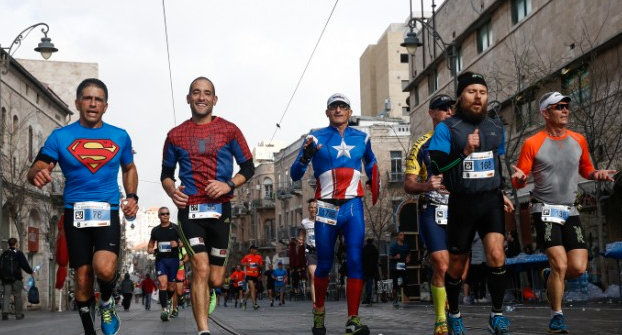
Friday was the sixth annual Jerusalem marathon. It was a chilly, bright morning and we were there to run the 10-kilometre race. (My son Shaya had been training to run the half marathon but had a bicycle accident three days before and was unable to participate. He calculated that he'd run the distance from home to Eilat in his training and sat sadly at home while we, the non-athletes, were able to run.)

There were several events going on, all leaving at different times. There was a full marathon, half marathon, 10-km run, 5-km run, a 1.7-km family run and an 800-metre special needs race. 


With 30,000 participants running through a city that has been plagued with Palestinian terror attacks nearly daily, this run seemed like it could be an organizational and security nightmare. Yet, Jerusalem had this one under control both logistically and security-wise. The mayor, who himself ran, said he would never give in to terror.

As so the races went on. And despite the terror and the press that streams horror stories on a daily basis, there were more foreign participants in this race than ever before. Some 2,400 people came to Jerusalem to run from 62 countries, double the amount of foreign participants from last year. They came from Uzbekistan, Argentina, Austria, Hong Kong, Singapore, Turkey, US, Switzerland and more—including 60 runners from China. The winner of the full marathon was a Kenyan who came in at 2:16:33.

The music blared as the runners passed the most scenic sights of town, including the Knesset, the Sultan’s Pool, Rehavia, King George and Jaffa Streets and Sacher Park. The highlight is always the sound of feet pounding the cobblestoned alleys of the Old City, going in the Jaffa gate and into the Armenian Quarter. And when there were uphills (of which there were many), crowds cheered, clowns clapped and live music thumped to buoy our tired spirits.

As Purim is in a few days, some people ran in costumes. Women wore tutus over their running pants, Spider Man and Super Man joined and many other capes flew by. Someone in the crowd was even giving out hamentashen to the runners. One wino, clutching a wine bottle at 10 am, insisted on shaking all the runners’ hands.

I noted the stronger presence of religious girls running this year. Wearing skirts and with long-sleeve shirts under their running shirts, they were pumped and ready to go. Along the way, many seminary girls cheered them on. I also saw a young Hareidi couple running together. This race was like one happy party of people from many places and of all ages having fun together. Families with tiny toddlers came out for the Family Run, while blind runners ran, attached by Velcro bands to a seeing runner. Young people accompanied disabled kids. People ran for charities, collecting money for wonderful causes.

To ensure our safety, there were 1,000 security personnel assigned to the race. Every road and pedestrian alley leading to the race was blocked. Police carried assault rifles. They sat on horseback near East Jerusalem and patrolled rooftops in the Old City.

To end a magical run, Amir was there to witness the most incredible sight at the finish line: a marriage proposal. As soon an one runner ended and was greeted by his girlfriend, he fell to the ground and presented her with a ring. Friends were there with a sign and cheering erupted everywhere. Amir caught this moment on video, yet another indication that Israel is all about living life to its fullest.


February 28, 2016

Dedicated Druze

IDF uniform, Druze flag.
The IDF base of Michve Alon is home to soldiers from all over the world. On base, soldiers from over 40 countries are integrated into the army. They learn Hebrew, get basic training and help with army placements. There are also many Israelis on this base, including Druze soldiers, who are there to improve their Hebrew skills.

The Druze make up less than 2% of the Israeli population, yet their strong presence in the IDF, sports, culture and politics is remarkable. See this list of remarkable Druze in Israel.  In fact, more Druze draft into the IDF than secular and Orthodox Israelis.

Courtyard of Nabi Shu'ayb Shrine, tomb of Jethro.
The Druze are a religious minority of Arab descent who call themselves Al-Muwahhidin, which means 'The Monotheists.' Their most revered descendant and chief prophet is Jethro, the father-in-law of Moses. And their most sacred place is Jethro’s tomb overlooking the Sea of Galilee.

They broke off from Islam in the 10th century and their relationship with Arab Muslims has been tense over the years. In the 1940s, Arab Muslims unsuccessfully tried to take over Jethro’s Tomb, worsening an already tenuous relationship.

Yet the Druze pledge allegiance to Israel and when it comes to serving in the army, they are very patriotic. Says the Druze poet Beda Mansour, “We are the only non-Jewish minority that is drafted into the military, and we have an even higher percentage in the combat units and as officers than the Jewish members themselves. So we are considered a very nationalistic, patriotic community.”

Originally, the Druze were drafted into their own unit called Gdud Herev, the Sword Brigade. After being separated from the Israelis for 41 years, the Druze said they wanted to be integrated. So in May 2015, the army disbanded the Herev unit and started integrating Druze soldiers into all units.

Druze leaders visit the navy.
This is enabling the Druze soldiers to attain higher echelons of command. And they are starting to succeed. Colonel Ghassan Alian became the second ever Druze officer to be commander of an infantry brigade.


There is much motivation in this community. 
According to the IDF, 80% of Druze men and women are drafted:
39% go into combat, including paratroopers and crack infantry brigades;
18% take quality courses that advance them into leadership positions;
17% go into technical support positions.

In fact, the commander of the Michve Alon base is Druze. Right now, there is a unit on Michve who are there to improve their Hebrew skills. Just last week, the Druze participated in a cultural evening and performed a special dance. The audience, soldiers at Michve from all over the world, clapped along and whistled, warmly welcoming them to the diversity that is Israel today.


May these soldiers help strengthen the army,  protect the land and be integrated into a vibrant, diverse Israel.


February 16, 2016

Here Comes the Sun


Field of lupines near my house.
The longer I live here in Israel, the harder it is for me to leave, even for a few days. I am not sure why this is, but after I return from being abroad, I am always struck as to how deeply tied I am to this land. Perhaps being away awakens a refreshing appreciation for this special country.

Israeli garden in February.
In Israel, when you travel abroad, you say you are going 'chutz l’aretz,' or ‘Chul' (an abbreviation for these words). These words first appeared in the Jerusalem Talmud, written in the 4th and 5th centuries, and express that when you leave Israel, you are not simply going away, but are going outside of the land. You cannot use these words when you depart from anywhere outside of Israel; this ancient expression is reserved only for when one leaves Israel. Leaving must have stronger implications than we think.

So I went to ‘Chul,’ traveling to London to celebrate a family simcha (Mazal Tov Jacob on your bar mitzvah….you were fabulous!) It was wonderful to reconnect with family as we have no close relatives in Israel.

Yet this was London in February and someone had turned off the lights! Permanently. I was shocked at how affected I was by the grey skies and the damp cold that sank into my bones. I consider myself as hardy seeing as I can camp outdoors on a rocky desert in the midst of winter; but I am weak when it comes to light deprivation. And this recent foray into ‘winter’ was a cold reminder of what made me pack up and leave Canada.


I was feeling so terrible when I was away last week, I actually became quite sick. Still unwell and recovering back in Israel under a deep blue sky, I thought I would look into the benefits of living in warm sunshine.

Here is what I learned:
* Light regulates the natural rhythms of our bodies
* We metabolize sunlight into important Vitamin D (and being deficient in Vitamin D can lead to many illnesses)
* Sunlight is beneficial to patients with Alzheimer's
* There is a strong connection with lack of sunlight and developing Multiple Sclerosis (MS is more common in populations that live farther from the equator)
* Sunlight heals psoriasis (a study shows that outdoor sunbathing therapy helped clear symptoms in 84% of patients)
* Sunlight improves our quality of sleep--when sunshine hits your optic nerve, it sends a message to produce melatonin which will helps you sleep better at night (melatonin is also a powerful antioxidant and has cancer-fighting properties)
* Sunlight kills bacteria and heals wounds
* Sun rays lower bold pressure in those who have high blood pressure
* Sunshine penetrates into the skin and cleanses blood vessels (a study showed that sunshine was beneficial  to people with artherosclerosis)
* Sunlight helps increase the oxygen in our blood and gives us stamina
* Sunshine, accompanied by blue skies, offers its very own benefits; blue light has recently been used in the treatment of of psychological problems, addictions, eating disorders, impotence, and depression. 
* People are often more productive in blue rooms so that blue sky must energize!
* Sunlight contributes to enhancing a good mood by increasing the level of a natural anti-depressant in our brain. Did you know that the brain produces more serotonin on sunny days than on cloudy days?

My garden writing nook.
Understanding the healing aspect of the sun is not modern science. The ancient yogis of India called the science of sunbathing Atapa Snana, while the Greeks called sunlight therapy heliosis. Today, we have lost the art. Many of us are forced to spend up to 90% of our lives indoors. Imagine this: noon sunshine offers 100,000 lux, yet when we sit indoors in an office under artificial lighting, we get 150-600 lux.

This lack of light eventually causes a disconnect with natural outdoor cycles. And as Henry David Thoreau wrote in 1862, “In Wildness, is the preservation of the world.”

I feel blessed to be living here in Israel, to be able to sit barefoot outside in the heat February under sunny, exhilaratingly blue skies. For here, I can heal and write and truly connect with the wildness of nature.

I invite you all to come join me for some Atapa Snana in Eretz Israel.

Sources: