Pages

February 27, 2017

If Ra'anana Were Rivendell...


 I’ve heard it said that Israel is a dangerous place. People from abroad have visions of a war-torn country, of simmering conflict, of injustice. They imagine a barrage of gunfire, thunderous tanks and shattering explosions.

Well, this is not exactly a precise description of Ra’anana. At least, not in terms of large weapons. In Ra’anana, we have another danger to contend with – and these new weapons are deadly. The assaulters are scary, negligent, belligerent and out of control. Civilians are scared to go out and the government will not protect us.
 
This new weapon is the electric bike. They have been sold here for the past few years and now every teen and pre-teen is driving one. Recklessly. As these kids do not have a driver’s license, they have no idea about traffic laws, yet they behave as a car and as a pedestrian, weaving across intersections onto sidewalks then back into the roads.

The typical electric bike rider travels without a helmet (or with their helmet dangling coolly on the handlebars), with a friend tucked in the front or hanging off the back. They neglect every law, whipping down one-way streets the wrong way, cutting through traffic circles, driving without any lights at night and talking on cell phones and smoking. They can get up to hefty speeds, enough to injure and kill pedestrians.  In 2015, four people died and 480 were hurt in biking accidents in Tel Aviv alone.

These bikes are in every city and town across the country and have become such a menace, the Knesset passed a bill outlawing these bikes to children under 16 years old. They also mandated that these cyclists must wear helmets and have lights at night.

We all breathed a sigh of relief when this bill was passed, hoping the scourge would be controlled. As of May 1, 2016, there would a 250 NIS fine given to those who broke the law. But when we saw young kids continuing to ride through the streets of Ra’anana, brazenly breaking the law, we asked the city what was going on.

The mayor’s office said they had no authority to stop them and that it was the police department’s problem. The police department said no, it was up to the city. So we became stuck in a dangerous, bureaucratic mess.

However, even if the police were to take this on, the task would be impossible: our city of 85,000 residents has been assigned by the state a piddling 7 police officers. They are already over worked with crime and traffic accidents.

I get so worked up about this issue, I thought I would appease my anger by attending a meeting of the Ra’anana Concerned Residents (RCR)  to understand what is being done.

I sat down in a room filled with animated people, mostly Brits and South Africans with a smattering of Israelis and Americans. The meeting started with the chairman first pointing out that they were happy to have the deputy mayor present.

“And where is the mayor?” some heckler called out.

The chairman threw up his hands then announced that although they invited the police, no police representative was here tonight.

 “Boo,” the crowd screamed. Bad police! (With seven police staff in a city of 85,000, I calculated the police were too busy to show up.)

There was a small presentation updating us on what was not being done and then they gave the microphone to the deputy mayor who proceeded to talk about posters and education and parents.

This was not the right approach, according to this crowd.

“Boo.” Bad mayor’s office. The audience was getting worked up and one elderly South African woman stood up and begged for a translation into English. Someone grabbed the mike and began to explain, but then someone else cried out, “That’s now what the deputy mayor said. That's your interpretation.”

“We don’t want to hear you talk. We want to know what the mayor’s office is saying.”

The evening deteriorated from here on. People grabbed the microphone and used the floor to complain, tell their own horror stories about encounters with bikes and propose their own solutions. These included self-policing, chaining up the bikes, closing the bike stores and insisting on driving tests and licenses for the bikes. (An amazing tax grab that any Israeli politician should relish.)

One adorably proper British woman explained how in England, the schools test children right in the schoolyard and only after they pass their bicycle test are they allowed to ride to school.

No electric bikes in Rivendell.
How sweet. And how impossible. This is not an English shire nor is it Tolkein’s Rivendell. This is the Middle East where there is no logic or law – should I let this Brit in on this?

The evening felt more like a therapy session than a constructive meeting.

There was so much frustration among the citizens, it is a shock the deputy mayor was not assaulted – and most of the people at this meeting were caring, law-abiding South African senior citizens. If they had good aim with their canes, they would have thrown them.

The meeting disintegrated and I went back to my car grumbling, more frustrated than ever.

As I pulled out onto the road in the pitch dark, I spied an electric bike coming my way. The rider had no helmet and no bike light. He was going the wrong way on the road. I let him pass, trying to calm my road rage, watching him cross a traffic circle the wrong way and cut sharply onto the sidewalk.

I shook my head and gripped the steering wheel. It is a miracle that more riders and pedestrians have not been killed or injured by these bikes.

On an administrative level, this issue is added proof that the very existence of this country is a miracle. For a first-world country, this place often feels like India on steroids.

Here is my solution to the scourge, thanks to Google and the gentle Dutch.


February 21, 2017

More than meets the eye

It was 3:30 in the morning when our alarm went off. We quickly dressed, made a coffee and jumped into the car. It was still pitch black outside, but the roads were clear as we drove north to Tsfat. 

We were quiet, in disbelief, feeling heavy and sad. A friend of ours from Canada had just passed away. He was a devoted husband, a father to a large family and a dynamic community leader.

He was a giver to countless charities and a sustainer of many others in need. And he was just in his early fifties. We were still numb from the shock of the news and knew the world already felt emptier with his passing.

Dawn was breaking as we drove into the ancient cemetery of Tsfat. Scattered over the mountainside, tzaddikim, learned rabbis, and Kabbalists are buried here in graves that date back over 2,000 years. Safed tradition recalls that Hannah and her Seven Sons, murdered by Antiochus during the Maccabean Revolt of our Chanukah story, are buried here.

It is also the place where the most famous Kabbalists are buried, including the Ari (Rabbi Isaac Luria), Rabbi Yosef Caro, Rabbi Moshe Alsheich, Rabbi Shlomo Alkabetz and Rabbi Chaim Vital. People come to Tsfat from all over the world to visit these graves where they pray and ask assistance of these great souls.

Typical of a winter's morning, the mountain was shrouded, enveloped in a thick cloud. I saw three busses parked outside and hundreds of Hassidim crowded into a tiny a room around the body. They were wearing long coats, some black and some striped. They had wide brimmed fur hats and long peyot. They all spoke in Yiddish.

Photo: Times of Israel
The body was rushed out to the freshly dug grave, mourners’ kaddish was recited and it was over.  Six of the man’s sons who had escorted their father’s body now stood in shock by the graveside. The parents of the deceased man and wife had stayed back home.

As the crowd turned to board the bus, someone we knew asked one of the mourners how they knew this great man.

“Who?”

The mourner did not even know the name of the man who had just been buried.  Yet these men came by busloads in the early hours of the morning to pay respects to a man they did not know personally.

And then they all left. The family also boarded a bus, heading back to Ben Gurion airport, probably making this one of the shortest trips to Israel on record.

Photo: Safed-home.co.il
The cemetery was now quiet. As the clouds cleared and the Old City of Tsfat was slowly revealed,  I stood alone, thinking about why a man would be buried so far from his home and his loved ones. And why he would have a funeral attended by strangers and placed in grave few would visit.

As I stood there, a dog wandered around the graves howling. I looked over and saw a flash of white and then too he was gone. There was something mystical happening here and I could not quite understand it. During this time, a friend of mine was having a vivid dream of this event.  She knew nothing of the death and funeral until much later and told me she woke up exhausted from her unusual dream.

Yes, there is more to this than meets the eye. Beside this newly covered grave is the kever of the Moroccan Kabbalist Rabbi Yosef Ohayon. And nearby is the grave of Rabbi Pinchas ben Yair, a relative of the famous Kabbalist Rabbi Shimon bar Yochai.

I then understood that this is the place for such a righteous friend. And being buried here in such a way was his ultimate act of modesty. It was quiet, quick and there was no fuss. If this burial had been done in his hometown, it would have been a huge send-off. Perhaps he had another, more uplifted vision for such a moment.

And so our friend was buried in a very ancient cemetery nearby the graves of tzaddikim. Perhaps his understanding of death is that it is not final, but simply a departure from one world to the other.

Standing at the graveside on this hushed morning, I felt as if he had deep knowledge of how to make a swift transition from this world. And humble, spiritual Tsfat was the place for this to happen.

Baruch Dayan Emet

Photo: Ascent Of Safed


January 30, 2017

What makes the desert beautiful?


"What makes the desert beautiful is that somewhere it hides a well."
Antoine de Saint Exupery

School vacationing in Israel corresponds with family time. For those who stay home, the go-to place is the mall where parents stuff their kids with fast food and sugar then invite them to watch mall puppet shows and concerts.  

The over-sugared kids then cannot sit down and concentrate so they basically rush around the mall as if it were an oversized playground.

If it is Chanukah, the outing always includes lining up forever to buy boxes of jelly donuts (Why do Israelis love munching in food courts and hanging out in malls?) 

And for those who can afford a family vacation, come December, the airports are packed with foreign tourists arriving and Israelis rushing out to Europe’s ski slopes and other exotic places.

This past Chanukah, my daughter’s friend was on a Mediterranean cruise with her family, my son’s girlfriend went to a resort in Eilat and our neighbor was so busy posting Facebook pics from the Swiss Alps, she probably had little time to hit the powder.

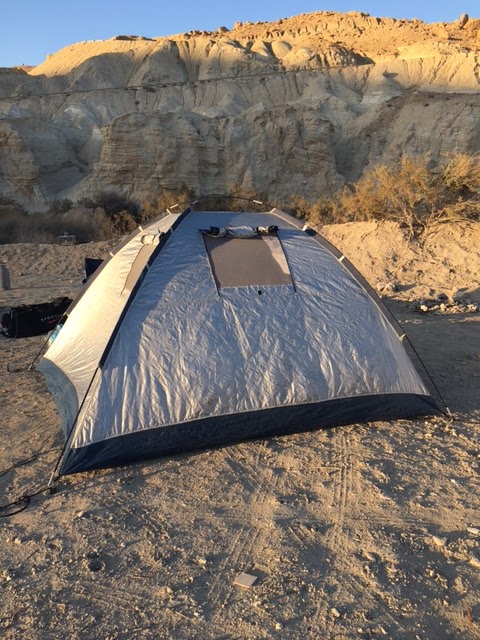
Our unusual family tends towards the adventure version of the so-called vacation. We stay away from malls and donuts and resorts. Instead, we pack up our tents, sleeping bags, food, pots and pans, tie wooden pallets to the top of our car (perfect for a bonfire) and head south to the desert. For Chanukah, we bring marshmallows, skewers and chocolate gelt for some Chanukah-themed ‘Smores.

This past December, we drove south to Midreshet Ben Gurion and set up camp at the foot of the Serpentine Road in Nahal Zin. The sun set behind the mountains, casting a purple glow across the rocks. As soon as the stars were twinkling, our fire was crackling and the marshmallows toasting. We were happy campers.

That is, until I tried to fall sleep. Sleep is elusive when I am camping. Every creaking twig becomes a vicious preying animal and every footstep a violent psychopath.

But that night I did not need my imagination to keep me awake. We had human neighbours blasting trance music and screaming right outside our tent.

As soon as they were tired out, I heard a pitter patter. This was no stalking wolf or coyote. It was real rain in the middle of the desert. Our snazzy tent was designed for stargazing and was not compatible with desert rain.

And so the drops fell right into our tent and pooled atop the sleeping bags, filling our hiking boots and drenching our already smelly, shivery dog.   

Did we consider rain in the desert? No.
Did we think to pack a tent fly for our desert adventure? No.

We had marshmallows, gelt and skewers – and a tent open to the skies. The soft drops became larger until puddles formed inside the tent. In response, I just lay there too tired to do anything about it.

Rain in a barren, bone-dry desert is magical, nourishing, rare. It is the hidden well that makes the desert beautiful. I tried my best to reframe and imagine the plants welcoming these life-sustaining drops. 

I must have been too cold or wet to be poetic. When our alarm went off at 5 am, it was pouring outside and inside. I was wet, shivery and because of the pouring rain, I could not even make a coffee on our portable gas stove. This was akin to disaster. After a sleepless night, I had no hope of evolving from my zombie state.

We shoved the sopping sleeping bags and our wet, shivery dog into the car.

After being fully awake all night, here I was, tired and soaking and about to start a long day of jeeping and hiking.

My last hope was that the hot desert sun would dry me out and warm me up.

We drove off into the dawn light of a cold, cloudy, drizzly day.  It looked more like the Scottish Highlands than the dunes of the desert. 

Hot revitalization was not meant to be. Maybe it was for those sunning in Eilat or cuddling under a feather duvet in a Swiss cottage. It was not happening here.

This was the start of our family vacation and I already dreamed of being back home. 

The real advantage to going on a rainy camping trip and having a flooded tent is that it really makes me appreciate the simple things in life: a roof over my head, a cozy duvet, a good night's sleep and a steaming coffee in the morning. 

I will return in sunshine to see the desert blooms that these rains bring. 

January 11, 2017

This is the place

“This is the place. Time to get out.”

I looked out the window of the jeep. Craggy rocks, red, towering mountains. I opened the door and hopped out. 

Rocks crackled as the car pulled away, disappearing in a cloud of dust.

And here I was. Alone. Utterly alone in a vast, silent desert. My only connection to the outside world was my cell phone, tucked into my pocket. I checked the phone to make sure I had connection. One thin bar flashed across my screen, a weak line out if I needed it.

Hands free. No heavy backpack this time. And no water. I felt as if I had been dropped onto Mars without oxygen. Or perhaps like a heli skier does when the helicopter drops him on a mountaintop into a world of pure, untouched nature. 


Unlike a skier, I was not forging a new trail. I had the comforting yellow, blue and white stripes of the Israel Trail markers to follow.

I cradled the phone one more time, my lifeline to help if I needed it, and started to run the trail. 

The sky was a deep blue, the air wintry fresh, the silence so strong, it felt as if it were a roar.  I breathed deeply and skipped along the path, the only sound being the crunch of rock beneath my feet.

I love to run and I love running unencumbered, freestyle. Without headphones in my ears and blasting music, it has become my form of meditation.

I was on this particular path to do a missing section of the Israel National Trail.  Having completed 900 km of the 1,000 km trail over the past three years, I am intent on doing it all. Running the trail all alone was a new variation as we usually hike slowly in a group laden with backpacks. 

So today I felt free, exhilarated and a tiny bit scared. This helped propel me forward through a barren wilderness reigned by rocks.

Life offers few opportunities to be utterly alone, to be surrounded by an empty silent expanse.  I wanted to breathe in the moment, to surrender to it and to heal from our modern world’s overload, tragedies and mess.


I know that if I do not make space for this, I will be swept up by it.  

And so I run. Because this is the place.

December 28, 2016

Letting Go

Facing each other and clutching a plate between our hands, we hold our arms out, lift gently, then lower. I take a deep breath. My partner lets go and I hold on firmly, lowering the china plate to the floor.

“You have to let go,” she says gently. “Let’s try again.”

I take another deep breath and we do it again. This time we let go at the same moment and the plate, safely enclosed in a bag, smashes into tiny shards.

“Mazal Tov!”

Brothers, sisters, nieces and nephews break into song, clapping and dancing. 

This small action speaks volumes as I now feel that my daughter is officially engaged. She has grown up, found a partner with whom she has decided to share her life and is leaving her childhood home to start anew.

My hands tightly clutched that plate just as I used to hold my daughter as a baby. And now my hands are empty. I have just let her go.

The two mothers peeked at the shards inside the bag. These tiny fragments can never be put back together and as such, are symbolic of our children’s commitment to leave behind their former lives. This is true finality and an ending of something big.

The smashed plate is also an echo of the glass that will be smashed under the chuppah, a powerful symbol that tells of the destruction of the Temple. Even at our happiest times, we must be reminded of brokenness and suffering.

The two mothers share in this tradition to show that we are now part of a new, combined family. I read a beautiful explanation that says the mothers’ power in breaking the plate is a symbol of the strength of Jewish women in upholding tradition and marriage.

Shutterstock image
This new combined family is also the completion of the bridge we built as olim. My husband and I brought our family to Israel 11 years ago. My now engaged daughter, who was ten years old when she arrived, could not speak Hebrew. The Israeli culture was surprisingly foreign and the customs were different.

The parents of both bride and groom have a shared story; we all arrived as Jews from the diaspora coming to Israel to build new lives.

For me, I originally thought aliyah was a simple process of learning Hebrew but have since realized that the differences run far deeper. Moving here as an older olah, I soon came to understand that we would never really acclimatize.

I then reframed and considered my husband and I to be bridge builders, not fully belonging in either Canada or Israel. We could only offer our children a sturdy bridge, but could do no more. When the time came, our children, who would be brought up here in Israel, would cross over.

And now my daughter has navigated her way and reached the other side. She is marrying a native-born Israeli (born to English speakers) and their language together is Hebrew. They both served in the IDF, listen to Israeli music, sing niggunim and learn Torah together, all in Hebrew. They have shared goals and want to live meaningful non-materialistic lives. 

I look at the two of them in wonder and amazement, never imagining this moment. I have let go of my daughter and she has let go of her Diaspora Jewish self to become part of something miraculous. 


Their path is so far from the other side of the bridge where we originated. Our new chatan and kalla will soon be building another beautiful Jewish home in Israel, leaving behind the bridge that these two plate-clutching mothers built and stood on.

As we lowered our arms and let go of the plate, we made space for the young couple to create their own path together. 

Soon we will sing this beautiful wedding song:

Again it will be heard in the cities of Judea,
And in the streets of Jerusalem,
The Voice of Joy and the Voice of Gladness
The Voice of the Groom and the Voice of the Bride!
Jeremiah 33:10-11


עוֹד יִשָׁמַע 
בְּעַרֵי יְהוּדָה 
וּבְחוּצוֹת יְרוּשָלַיִם 

קוֹל שָשוֹן וְקוֹל שִמְחָה 
קוֹל חָתָן וְקוֹל כָּלָה

Mazal Tov to 
Aviva and Shaarya!